Newsletter Subscribe
Enter your email address below and subscribe to our newsletter

 ByJohn A
An ankle sprain can affect more than the injured joint. For seniors, pain, swelling and loss of stability can make walking, going up and down stairs or doing daily activities more difficult. An ankle brace for sprains can provide external support during the healing process, but depending on the type of brace, there are different degrees of compression, stability and restriction of motion.
Understanding these differences can help older adults and caregivers consider the type of support that may be appropriate for a particular situation. An ankle brace may also be a component of a larger strategy to ensure safe mobility during recovery.
An ankle sprain may temporarily affect balance, weight-bearing, and confidence while walking. The impact can be greater if the older person already has poor mobility or is struggling to adjust to changes.
An ankle brace for sprains could also help with stability during the recovery process, and adaptive equipment for seniors can help with other issues related to moving, transferring, and daily activities. The appropriate combination will be determined by the person and the type of injury suffered.
Ankle braces differ in their level of compression, flexibility, and support, making each design suited to different recovery needs.
Compression sleeves are lightweight and comfortable and are designed to provide ankle mobility with enough compression around the ankle joint. These can be considered if an ankle brace for sprains is necessary for relatively mild support and comfort and flexibility are important.
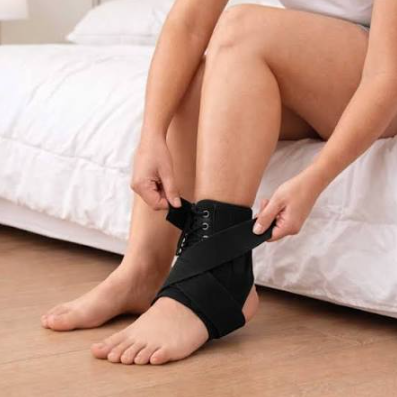
The lace-up brace uses adjustable closures around the ankle to provide a more secure fit. They tend to offer a greater degree of support than just a compression sleeve and allow for some movement. When recovering from a sprain, it may be helpful to have an ankle brace that can be adjusted to fit snugly when swelling changes or the individual needs more comfort.
Semi-rigid and stirrup designs typically provide greater side-to-side support than softer braces. They can provide the structure to prevent excessive movement at the ankle without compromising mobility. For seniors using adaptive equipment for seniors, this type of external support may be relevant when additional ankle stability is needed during everyday movement.
Rigid braces offer considerably more restriction and protection than flexible braces. They may be used when an ankle brace for sprains needs to provide greater control of ankle movement, depending on the injury and stage of recovery. The level of restriction and support should be chosen appropriately, not just on the basis of the amount of immobilisation, with medical advice.
An ankle brace addresses support around the injured joint, but recovery can also create challenges elsewhere in the home. Adaptive equipment for seniors can help with activities affected by reduced mobility, while bathroom grab bars for seniors can improve stability during bathroom transfers.
Other medical products serve completely different purposes. A cervical collar for neck support will limit or facilitate the movement of the neck when indicated by medical conditions, and a blood glucose meter kit will be helpful for routine monitoring of blood glucose. Therefore, the choice of these products must be made based on their specific function and not as ankle support alternatives.
The ankle brace for sprains by IDTS Home Medical Supply provides safer mobility for seniors. The brand also offers hands-on home medical supplies for specific mobility, safety and healthcare requirements, ensuring users and caregivers can access a variety of equipment, as well as other items that facilitate daily care and mobility at home. The availability of appropriate equipment in one place may facilitate meeting the changing needs during the recovery and normal home care processes.
The time to use an ankle brace for sprains will vary according to the sprain, symptoms and stage of recovery. You can ask a health care provider about how long and when it should be worn.
An ankle brace for sprains can be worn with appropriate footwear, as long as there is adequate room for a comfortable, secure fit. Tight footwear may cause pressure or discomfort.
Generally, an ankle brace for sprains should only be used at night if the injury and medical advice suggest it for such situations. Senior citizens should adhere to the recommendations for their recovery situation.
Adaptive equipment for seniors can support mobility during recovery, while bathroom grab bars for seniors can provide added stability during bathroom transfers and other movements.
The right ankle brace for sprains can offer valuable external support; however, the best choice relies upon the injury, required support, and the mobility requirements of the individual. Practical adaptive equipment for seniors can also address some of the issues faced when recovering from an injury and make daily life easier with appropriate ankle support.
Explore ankle supports and practical home medical equipment at IDTS Home Medical Supply to make recovery and everyday mobility easier.